
Platonic Solids
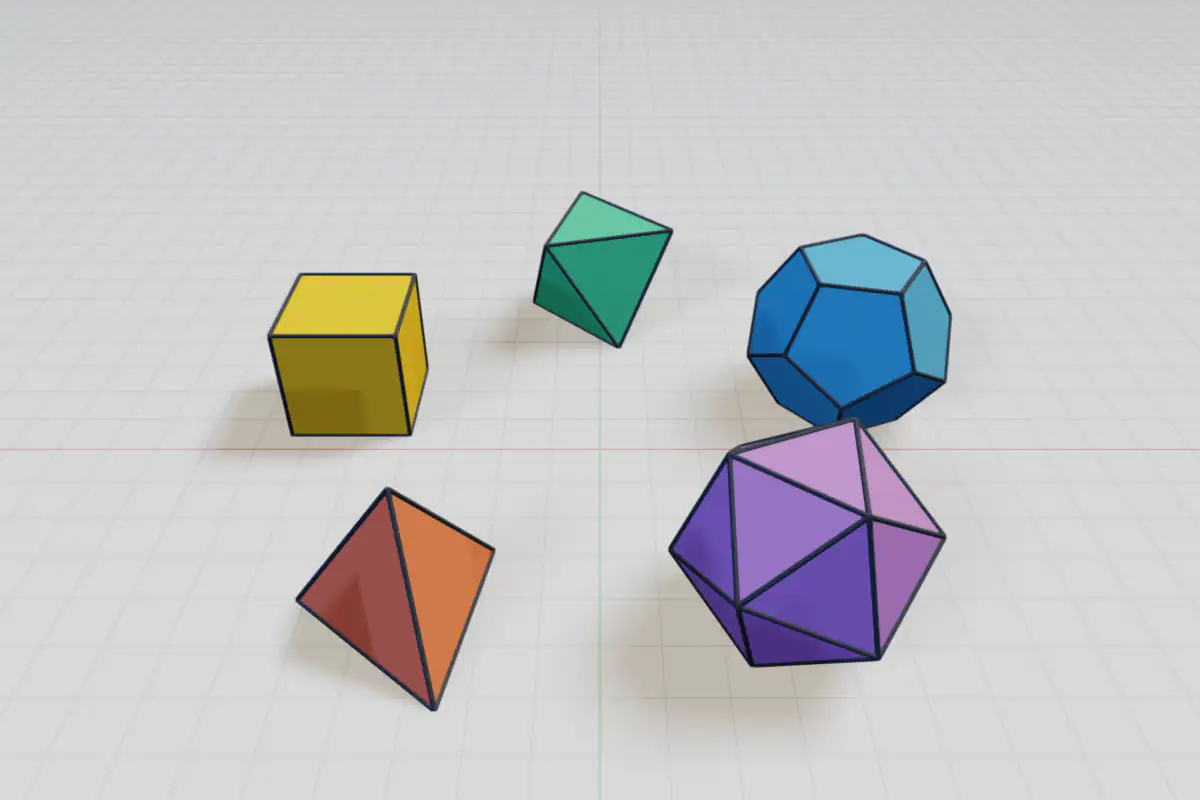
The five regular convex polyhedra, side by side, each built from a vertex list and a face table.
A Platonic solid is a convex polyhedron whose faces are all the same regular polygon, with the same number of faces meeting at every vertex. There are exactly five: the tetrahedron, the cube, the octahedron, the dodecahedron and the icosahedron. Euclid proved in the last book of the Elements that no others exist: the angles of the faces that meet at a vertex must add up to less than 360^\circ , and only five combinations of equilateral triangles, squares and regular pentagons do. Plato associated four of them with the classical elements, and Kepler tried to fit the orbits of the planets between them.
Each solid here is a mesh: a list of vertices and a table of triangular faces. The square faces of the cube and the pentagonal faces of the dodecahedron are each split into triangles, and the dark tubes draw only the true edges, the pairs of vertices at the edge length. The coordinates come from the golden ratio \varphi = \frac{1+\sqrt5}{2} : the twelve vertices of the icosahedron are the corners of three golden rectangles in the three coordinate planes. All five solids are scaled to fit in spheres of the same radius and rest on one face. Read around the pentagon from the front left, the face counts are 4, 6, 8, 12 and 20 . The cube and the octahedron are duals, as are the dodecahedron and the icosahedron: the face centers of one are the vertices of the other. The tetrahedron is its own dual.
After a Desmos graph by Brandon Roller.
JavaScript is required to view the interactive plot.