
Conchoid of Sluze
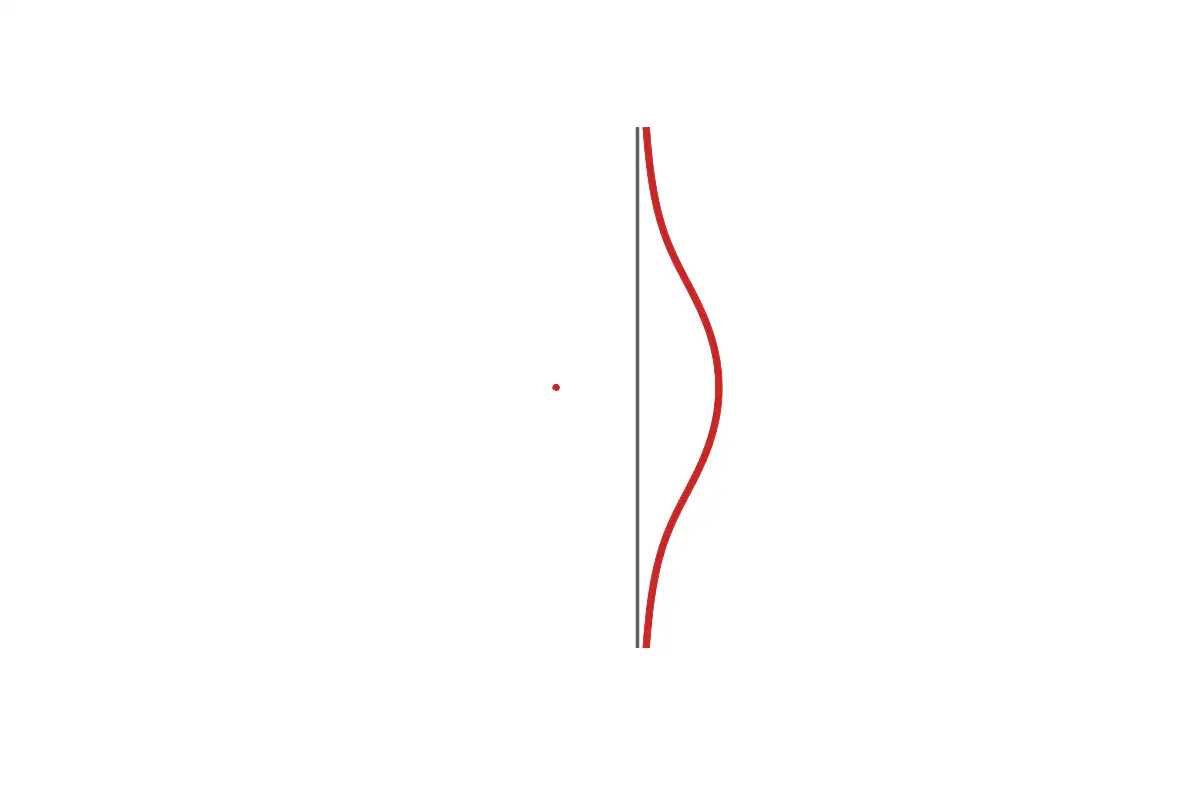
An implicit algebraic curve with a cusp and asymptote at x = 1.
The conchoid of de Sluze, studied by the Belgian mathematician René-François Walther de Sluze in the 17th century, is an algebraic curve defined by an equation of the form a(x - 1)(x^2 + y^2) = k \cdot x^2 . It is one of a family of cissoids and conchoids that classical geometers used to attack construction problems — including angle trisection and cube duplication — that could not be performed with compass and straightedge alone.
The plot renders the implicit equation (x - 1)(x^2 + y^2) - x^2 = 0 in red, with the vertical line x = 1 drawn in gray as a reference. The curve approaches that vertical asymptote at large |y| and develops a small cusp and self-intersecting node near the origin where the cubic geometry becomes singular. The combination of vertical asymptote and local singularity captures how a single low-degree polynomial encodes both far-field and short-range behavior.
JavaScript is required to view the interactive plot.