
Implicit Bouquet
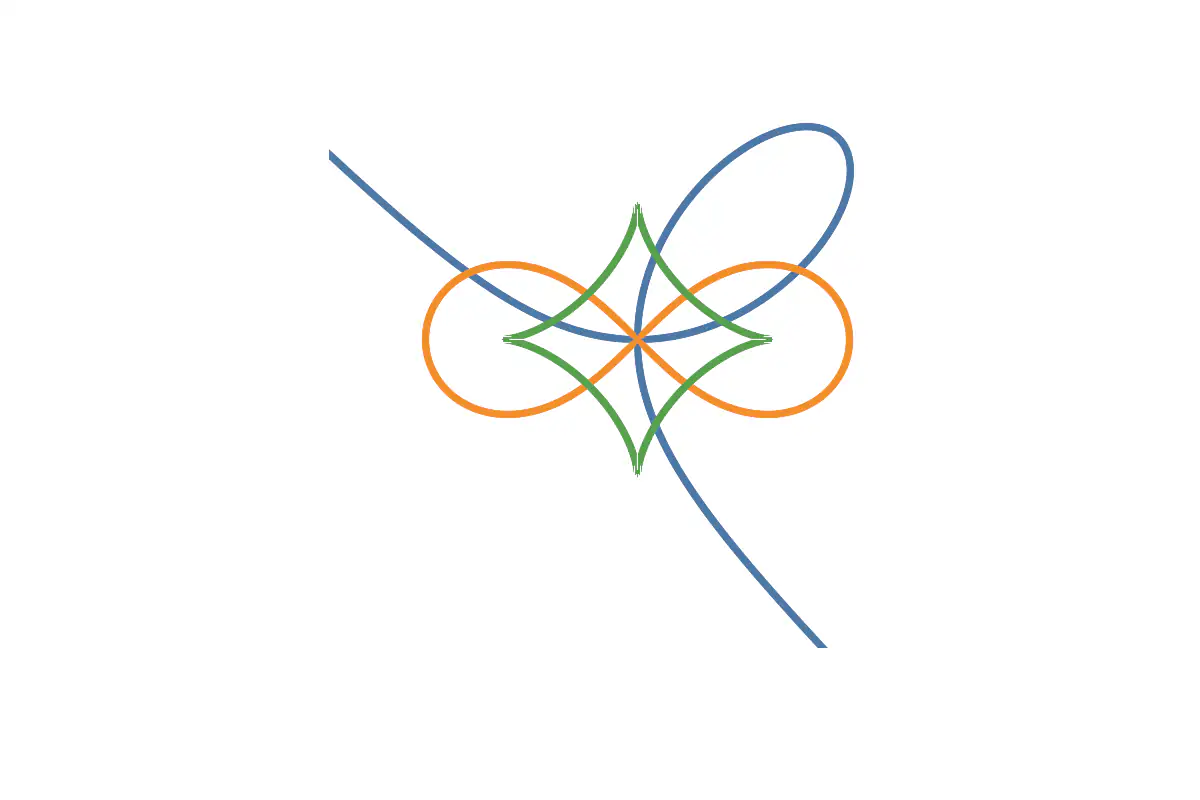
Folium of Descartes, Bernoulli lemniscate, and astroid composed in one implicit plot.
Implicit curves — defined as zero sets f(x, y) = 0 — are the natural language for algebraic geometry over the real plane. Many classical shapes are most cleanly described this way: folia, lemniscates, astroids, cardioids, and conics all have compact polynomial defining equations but resist neat expression as y = f(x) . Plotting them via marching-squares or similar methods avoids the branch-handling that explicit form would require.
The bouquet combines three classical implicit curves on one equal-aspect plane: x^3 + y^3 - 3xy = 0 (the folium of Descartes, first studied by Descartes in 1638), (x^2 + y^2)^2 - 2.5(x^2 - y^2) = 0 (a Bernoulli lemniscate), and |x|^{2/3} + |y|^{2/3} - 1 = 0 (the astroid traced by a small circle rolling inside a four-times-larger one). Overlaying them shows how loops, cusps, and symmetric petals coexist in the same coordinate system while each defining equation remains in its natural algebraic form.
JavaScript is required to view the interactive plot.