
Spiral Galaxy
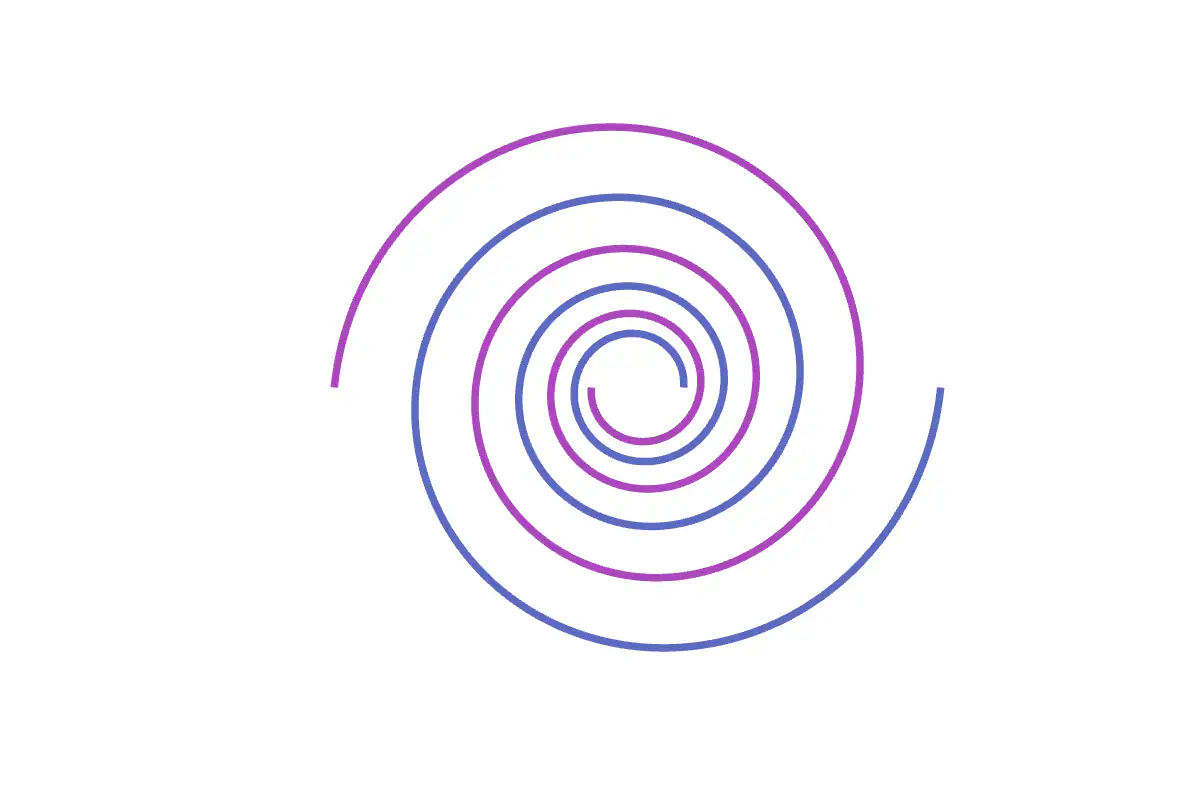
Logarithmic spirals winding outward — the blueprint of spiral galaxies.
A logarithmic spiral, sometimes called an equiangular spiral, is the curve r = a \cdot \exp(b \cdot \theta) : its radius grows by a constant multiplicative factor with each full turn. Jakob Bernoulli, who studied it in the 17th century, was so taken with its properties that he requested it engraved on his tomb. The same shape arises in nautilus shells, hurricane bands, sunflower seed heads, and the arms of barred spiral galaxies, where it approximates the trailing edges of star-forming regions.
The visualization draws two logarithmic spirals with radius \exp(0.1t) , one with angle t advancing from 0 to 6\pi and the second offset by \pi so it starts on the opposite side. The result is a galaxy-like figure with two arms unwinding outward at the same constant pitch angle. The plot is purely geometric — no astrophysical simulation — but it captures the defining property: equal angular advance always multiplies radius by the same factor.
JavaScript is required to view the interactive plot.