
Lorenz Attractor
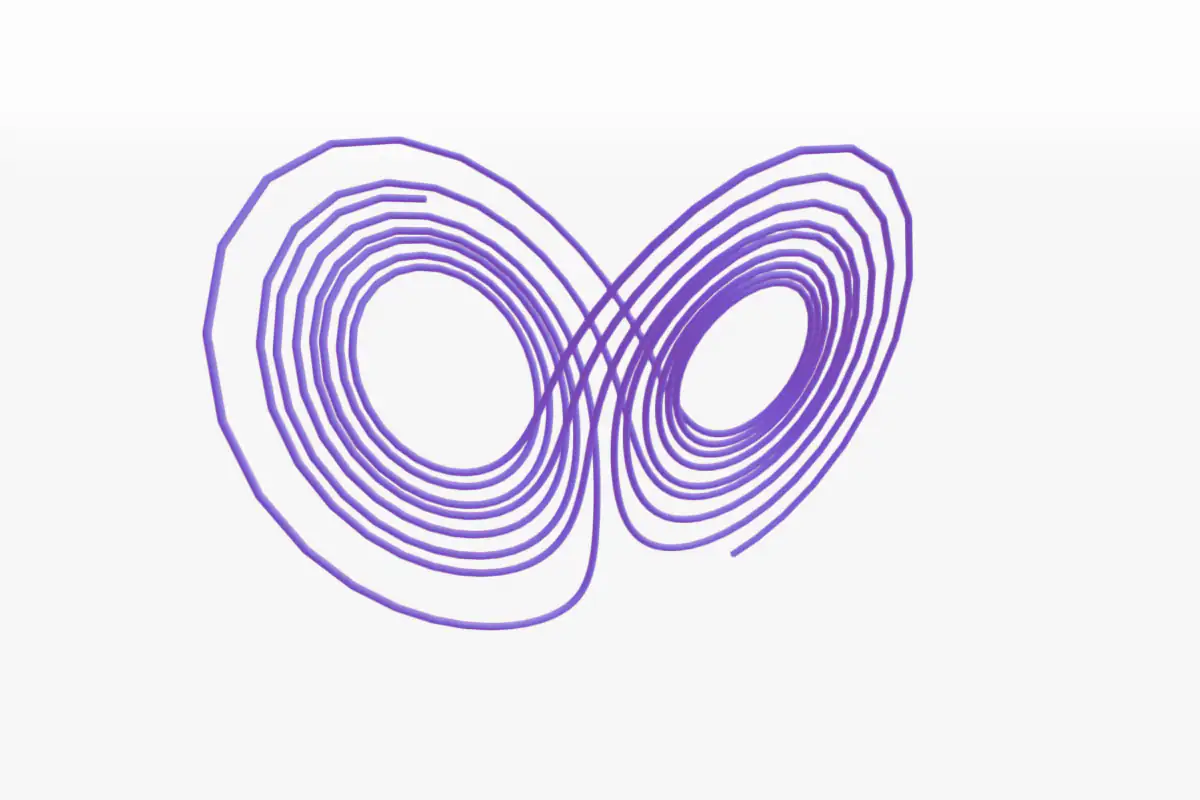
Edward Lorenz's model of convection, integrated live in 3D: the orbit never repeats, yet it stays on a butterfly-shaped attractor.
In 1963 the meteorologist Edward Lorenz reduced a model of convection in the atmosphere to three equations: x' = \sigma(y - x) , y' = x(\rho - z) - y , z' = xy - \beta z . With his values \sigma = 10 , \rho = 28 and \beta = 8/3 the solutions never settle and never repeat, and two solutions that start very close together soon follow completely different paths. This sensitivity is the "butterfly effect", and the shape the solutions trace, two wings around two unstable centres, is the Lorenz attractor.
This document computes a solution step by step. The state is the list S = [x, y, z] . An action runs every 30 ms and takes one fourth-order Runge–Kutta step of size h : it evaluates the derivative K_1 at S , K_2 and K_3 at two midpoints, and K_4 at the end of the step, and moves S to S_n = S + \frac{h}{6}(K_1 + 2K_2 + 2K_3 + K_4) . The action also appends each new state to the lists P , Q , R , which draw the last 600 states as a trail.
Edit \rho to see other behaviours: below about 24 the orbit, after some time, spirals into one of the two centres, and from about 24.74 upward it stays on the chaotic attractor. The second action restarts from (1, 1, 1) with an empty trail, so you can watch the orbit settle onto the attractor.
After a Desmos graph by Fabrice Neyret.
JavaScript is required to view the interactive plot.