
Wave Interference
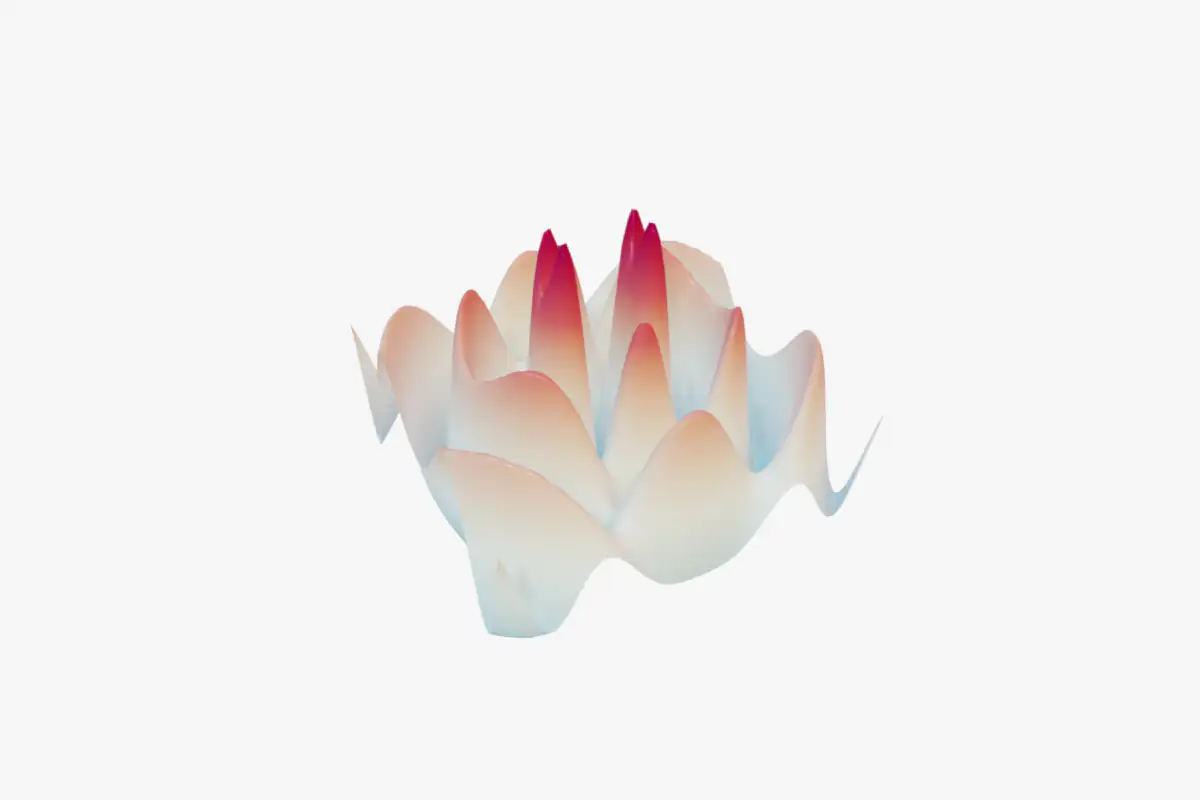
Two point sources create ridges of constructive and destructive interference.
Wave interference is the linear superposition of two or more wave fields: when crests align they reinforce, and when crests meet troughs they cancel. Interference patterns underlie diffraction gratings, double-slit experiments, antenna arrays, noise-cancelling headphones, and the colored fringes seen in thin films and soap bubbles. They were first systematically studied by Thomas Young in 1801, establishing the wave nature of light.
The surface visualizes interference from two point sources fixed at x = -2 and x = 2 . From each source a damped radial wave \sin(2r)/(1 + 0.3r) propagates outward, and the displayed height is the sum of the two contributions. The RdBu diverging palette assigns warm tones to crests and cool tones to troughs, so constructive interference appears as bright ridges and destructive interference as flat or sunken regions, particularly along the hyperbolic curves of equal path difference.
JavaScript is required to view the interactive plot.