
Buck-Boost Converter
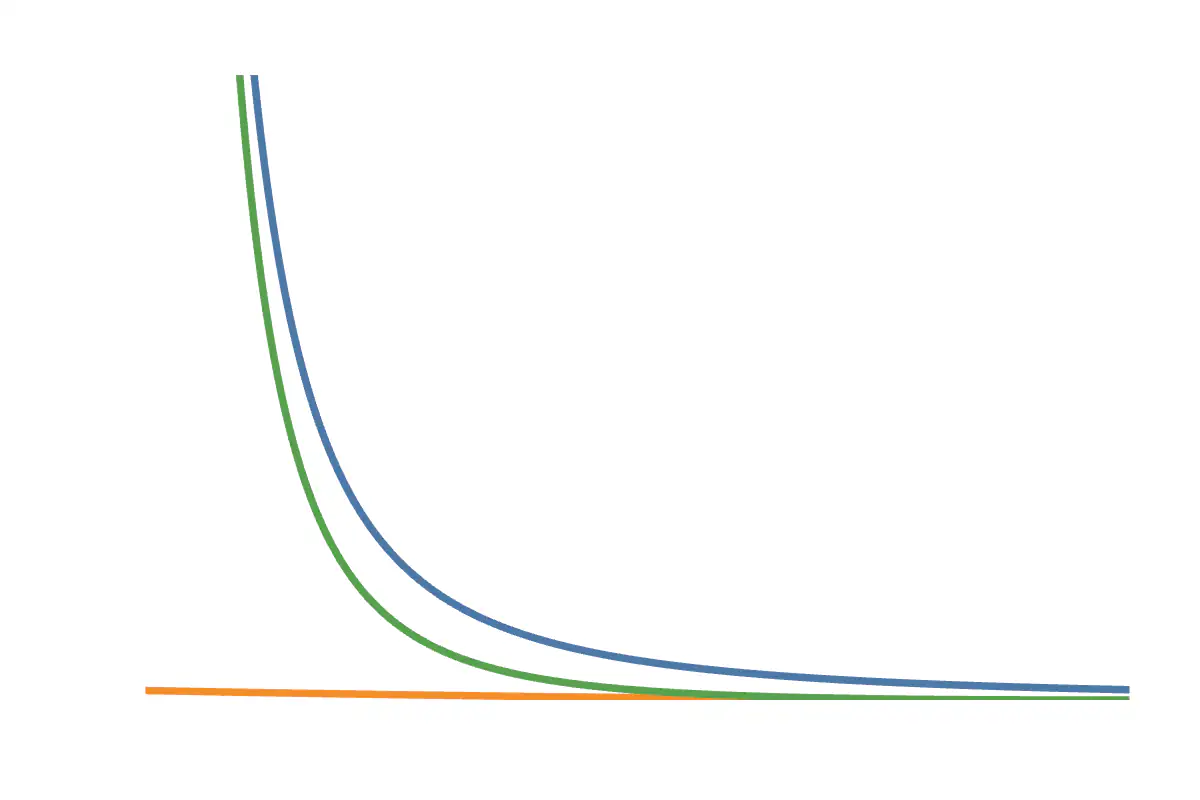
Normalized input resistance vs. duty ratio for buck, boost, and buck-boost DC-DC converters.
A buck-boost converter is a DC-DC switching power-supply topology that can either step a voltage down (buck) or step it up (boost) depending on the switching duty ratio. The ideal output-to-input relationship is governed by the conversion ratio V_\text{out}/V_\text{in} = -D/(1 - D) , where D is the fraction of each switching cycle that the main switch is on. Buck-boost stages are central to battery-powered electronics, LED drivers, photovoltaic harvesting, and any system where the input voltage can be either above or below the regulated output.
The plot compares three normalized duty-ratio terms — 1/t^2 , (1-t)^2 , and (1-t)^2/t^2 — on a shared horizontal axis, with t playing the role of the duty ratio in the open interval (0, 1) . The boost-related curves blow up as t approaches zero because of division by t^2 , while the buck term decays smoothly toward zero as t approaches one. The crossing region near t \approx 0.5 corresponds to unity conversion, where buck and boost behavior meet.
JavaScript is required to view the interactive plot.