
Spherical Harmonics
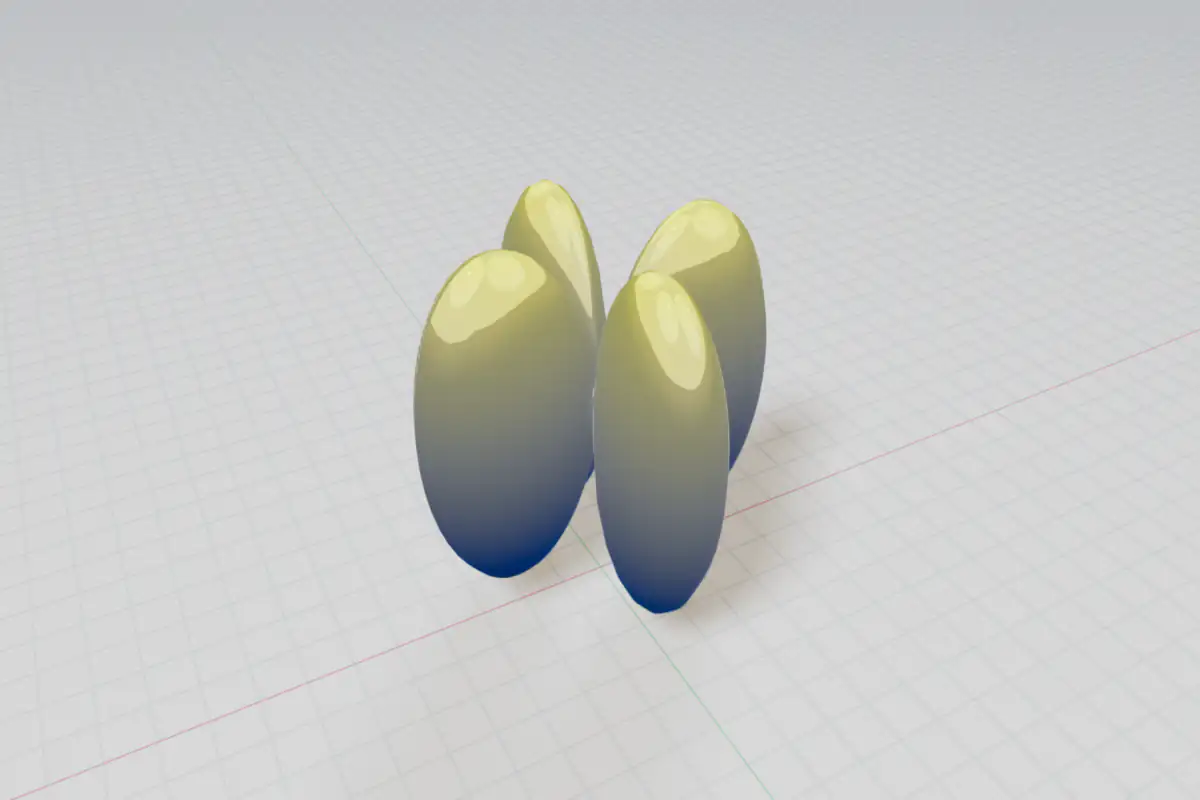
The angular shape of atomic orbitals — four lobes of a d-orbital.
Spherical harmonics are the angular eigenfunctions of the Laplace operator on the sphere. They form a complete orthonormal basis for square-integrable functions on the sphere — the spherical analogue of Fourier series. They appear throughout physics: in the angular part of the hydrogen-atom wavefunctions, in models of planetary gravity and Earth's magnetic field, in cosmic-microwave-background analysis, and in spherical convolutions used for ambient lighting in computer graphics.
The radial surface r = 2|\sin^2(u)\cos(2v)| is plotted over u \in [0, \pi] and v \in [0, 2\pi] , producing a shape with four prominent lobes that match the angular pattern of a real harmonic with \ell = 2 and m = \pm 2 . The absolute value folds positive and negative lobes onto the same radial direction, so the lobes are visually emphasized rather than hidden inside a unit sphere. The chrome material and hidden axes keep attention on the rotational symmetry of the shape.
JavaScript is required to view the interactive plot.