
Damped Oscillation
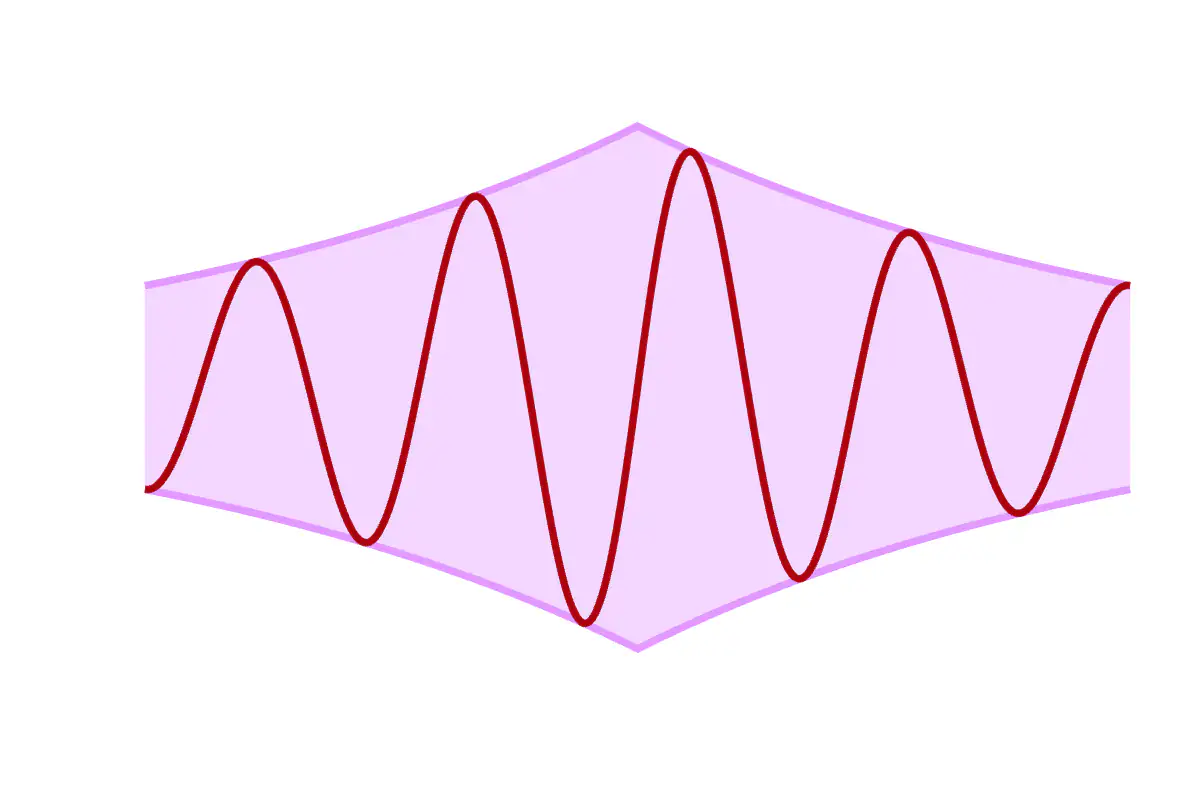
A decaying sinusoid whose damping coefficient animates — the exponential envelope tightens and loosens as c sweeps.
A damped oscillation is periodic motion whose amplitude decays over time or distance, typically because energy leaves the system through friction, resistance, or radiation. Damped harmonic motion is the textbook model for mass-spring systems, RLC circuits, pendulums in viscous fluid, and many vibrating mechanical structures. The decay envelope determines how quickly the oscillation fades and whether the system rings, deadbeats, or returns smoothly to rest — distinctions classified as under-, critical-, and overdamped behavior.
The plot shows \exp(-c|x|)\sin(1.5x) across -3\pi to 3\pi , with the damping coefficient c animating from 0.05 to 0.6 . The purple curves are the positive and negative envelope \pm\exp(-c|x|) , and the shaded band between them marks the allowed amplitude. As c rises the envelope clamps the wave down ever faster (heavily damped), while a small c leaves a nearly sustained oscillation; the frequency stays fixed throughout, so c changes the decay rate without touching the rhythm.
JavaScript is required to view the interactive plot.