
Boy's Surface
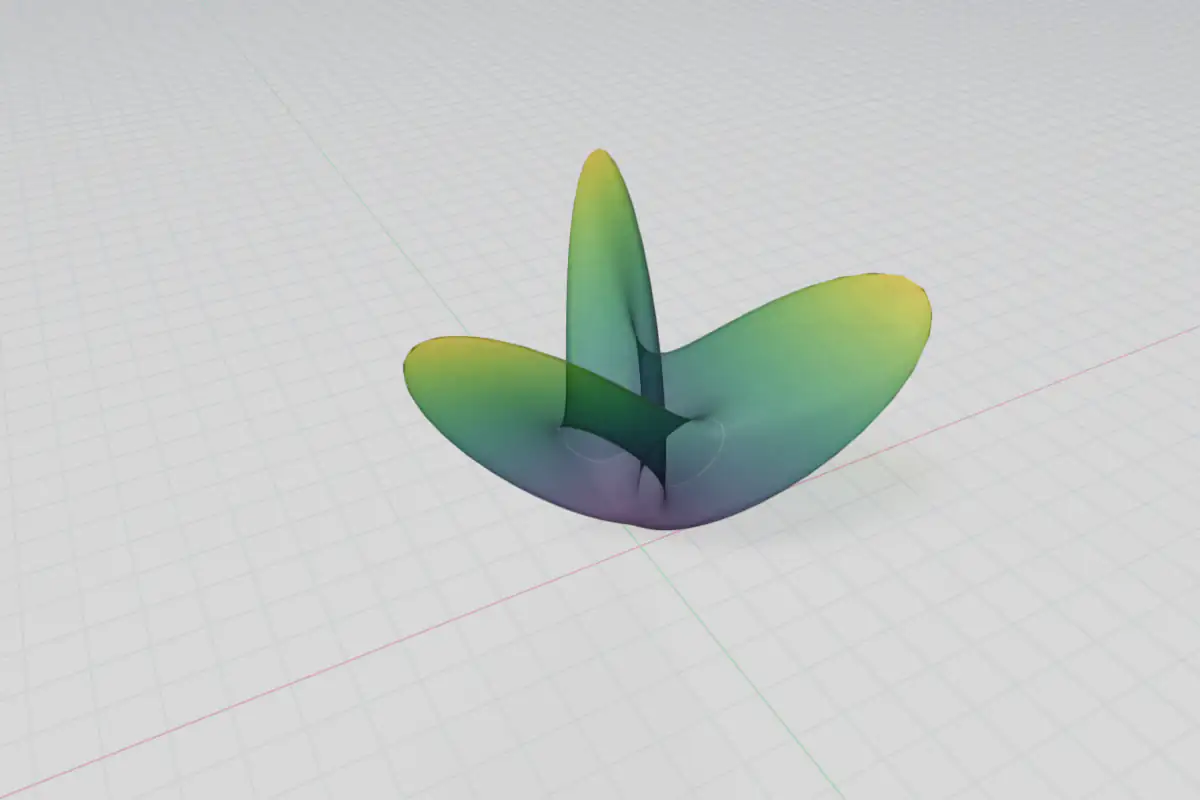
Rotate Boy's surface in 3D: a one-sided immersion of the projective plane with three-fold symmetry and one triple point. Edit the parametric equations.
Boy's surface is an immersion of the real projective plane in three-dimensional space: a closed, non-orientable surface with no edges, whose only singularities are self-intersections. It was discovered in 1901 by Werner Boy, a doctoral student of David Hilbert, who had asked Boy to prove that no such immersion could exist; Boy found one instead. Unlike the Roman surface and the cross-cap, two other models of the projective plane in space, Boy's surface has no pinch points: it passes through itself along a curve of double points, and this curve passes through a single triple point, which gives the surface its three-lobed shape with three-fold symmetry.
The rendering uses the parametrization x = (\sqrt{2}\cos(2u)\cos^2 v + \cos u\sin(2v))/D , y = (\sqrt{2}\sin(2u)\cos^2 v - \sin u\sin(2v))/D , z = 3\cos^2 v/D , sharing the denominator D = 2 - \sqrt{2}\sin(3u)\sin(2v) , with u \in [-\pi/2, \pi/2] and v \in [0, \pi] . Because |\sqrt{2}\sin(3u)\sin(2v)| \le \sqrt{2} < 2 , D never vanishes, and the formula is smooth and bounded everywhere. The three lobes fold over one another and meet at the central triple point.
The self-intersection of Boy's surface has a simple structure. There is exactly one triple point, where three sheets of the surface cross. The double curve, the set of points where two sheets cross, is made of three loops that leave the triple point and come back to it, so six arcs of the double curve meet at the triple point. The surface has no other singular points, and it can be cut into three congruent pieces. Boy's surface is one of only two immersions of the projective plane with a single triple point. The other one, called Girl's surface, has the same set of intersection lines but less symmetry.
The three-fold symmetry can be read from the formula: replacing u by u + 2\pi/3 leaves z and D unchanged and turns the point (x, y) by 4\pi/3 about the z -axis. The surface is therefore unchanged by a rotation of a third of a turn about that axis.
Rotate the surface to look down the z -axis and you see the three lobes around the axis; tilt it, and the glass material shows the double curve inside, where the sheets pass through one another.
JavaScript is required to view the interactive plot.