
Roman Surface
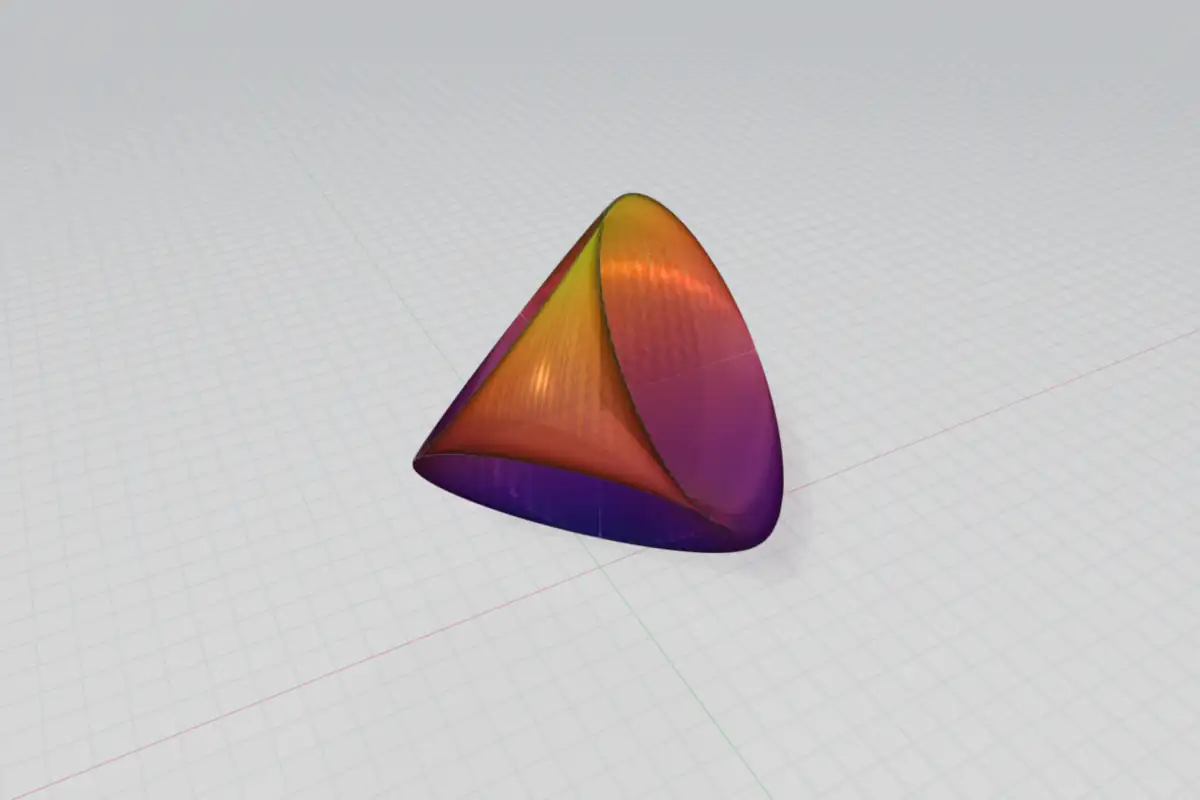
Rotate Steiner's Roman surface in 3D: a quartic model of the projective plane with tetrahedral symmetry and a triple point. Edit the parametric equations.
The Roman surface, found by Jakob Steiner in 1844 during a stay in Rome, from which it takes its name, is a quartic surface that maps the real projective plane into three-dimensional space. It is the image of the unit sphere under the quadratic map (x, y, z) \to (yz, zx, xy) ; because every coordinate is a product of two, antipodal points of the sphere land on the same image, so the map descends to the projective plane. Unlike Boy's surface, the Roman surface is not a smooth immersion: it has three segments of self-intersection meeting at a triple point at the origin and terminating in six pinch points, and it has tetrahedral symmetry, with one lobe at each corner of a tetrahedron.
The parametrization substitutes the spherical coordinates (\cos u\sin v, \sin u\sin v, \cos v) of a point of the unit sphere into that map: x = \frac{1}{2}\sin u\sin(2v) , y = \frac{1}{2}\cos u\sin(2v) , z = \frac{1}{2}\sin(2u)\sin^2 v , with u \in [0, 2\pi] and v \in [0, \pi/2] . The upper hemisphere is enough, because it contains at least one point of each antipodal pair. The glass material lets the three internal double-line creases and the central triple point show through the rounded tetrahedral shell, where an opaque surface would hide them. Steiner himself never published the surface; it first appeared in print in 1863, in a paper by Ernst Kummer to the Berlin Academy, to which Karl Weierstrass added a note on Steiner's construction.
The implicit equation of Steiner's Roman surface for a sphere of radius r is x^2y^2 + y^2z^2 + z^2x^2 = r^2xyz (Wikipedia writes it as x^2y^2 + y^2z^2 + z^2x^2 - r^2xyz = 0 ); in this plot r = 1 . The left side is never negative, so the surface lies only where xyz \ge 0 , in the four octants that hold the four lobes. Permuting the coordinates, or changing the signs of two of them, leaves the equation unchanged; these 24 operations are the symmetries of a regular tetrahedron.
The three double lines are segments of the coordinate axes. On the x -axis the surface covers -\frac{1}{2} \le x \le \frac{1}{2} , and each point inside that segment is the image of two different points of the projective plane: two sheets of the surface cross there. At the six ends, such as (\frac{1}{2}, 0, 0) , the crossing stops in a pinch point, a Whitney umbrella, where the surface has no tangent plane. The implicit equation also holds on the rest of each axis, beyond the pinch points, where the parametrization does not reach.
Boy's surface is also an image of the real projective plane, but it is an immersion: it crosses itself along curves and has no pinch points. Rotate the Roman surface to look down the z -axis: the four lobes appear in the four quadrants, alternately near and far.
JavaScript is required to view the interactive plot.