
Möbius Strip
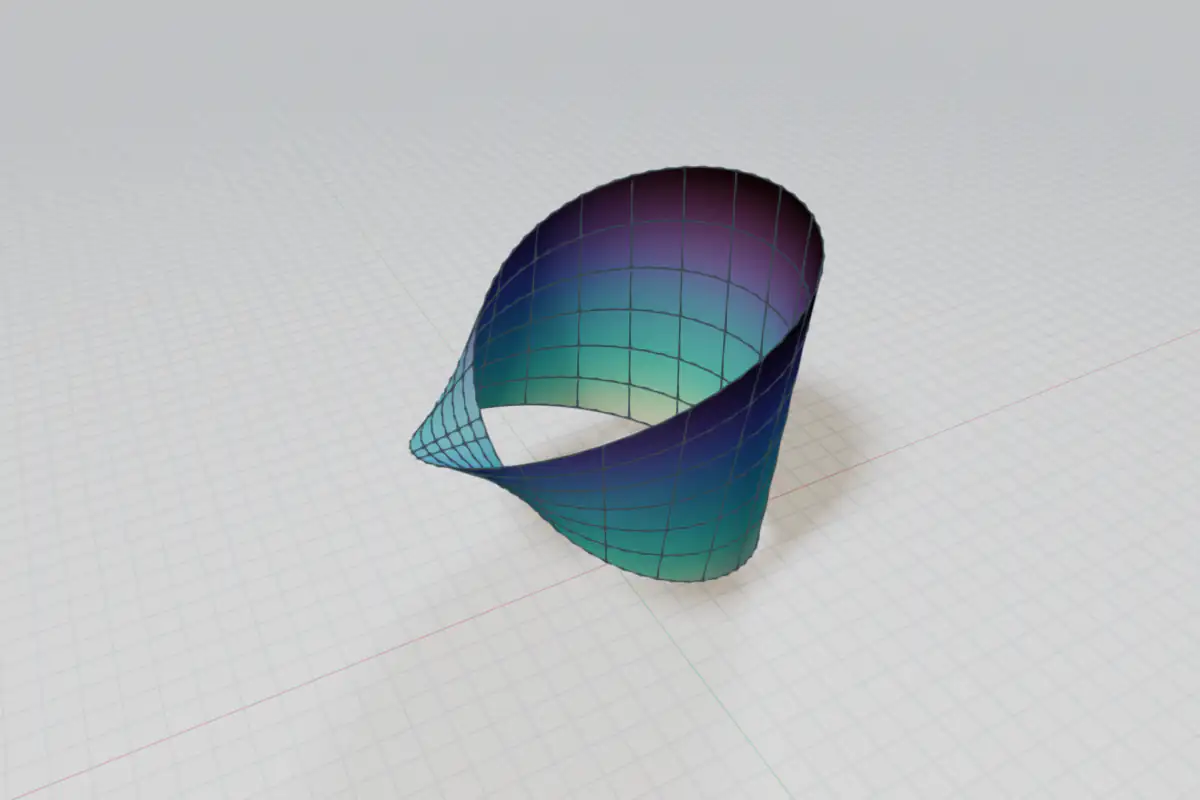
A surface with only one side — follow the edge and you return flipped.
A Möbius strip, discovered independently in 1858 by August Möbius and Johann Listing, is the simplest example of a non-orientable surface. It has only one side and only one boundary curve: a finger traced along the surface returns to the starting point inverted, and a finger traced along the edge follows a single loop twice the length of the original strip. The Möbius strip is a foundational object in topology and a recurring motif in art, design, and conveyor-belt engineering.
The parametric form sends u once around the loop while v sweeps a narrow band from -0.4 to 0.4 , with half-angle terms \cos(u/2) and \sin(u/2) producing the single half twist. The wireframe makes that twist easy to follow visually: walking along the band once arrives on the opposite side, and a second pass is required to return to the original orientation — a direct illustration of non-orientability.
JavaScript is required to view the interactive plot.