
Saddle Surface
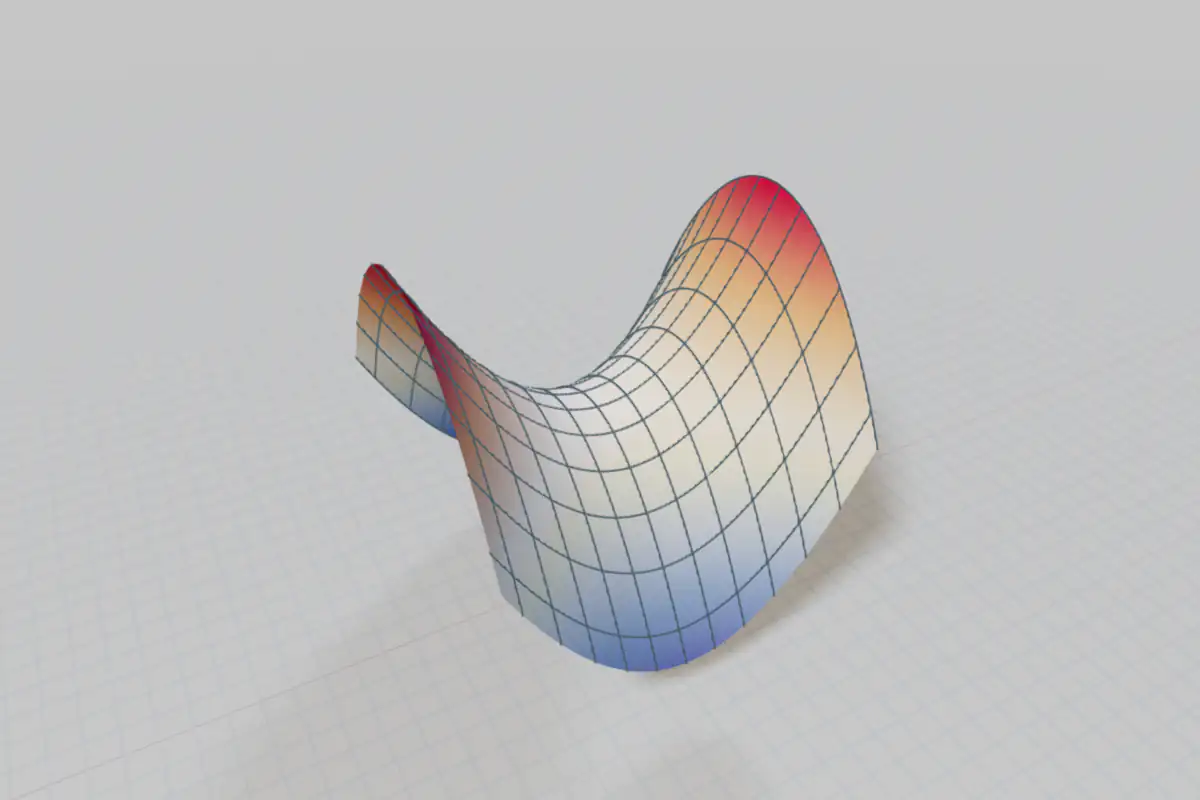
A hyperbolic paraboloid — curves up in one direction and down in the other.
The hyperbolic paraboloid z = x^2 - y^2 is the prototypical saddle surface. It is a doubly ruled surface, meaning two distinct straight lines pass through every point, which is why hyperbolic paraboloids appear in architecture as elegant roof shells (the Pringles potato chip is the everyday example). At the origin the surface curves upward in one direction and downward in the perpendicular direction, making it a classic example of a saddle point in multivariable calculus.
Rendered over -3 \le x, y \le 3 with the coolwarm diverging palette, the wireframe shows positive height in warm tones and negative height in cool tones. The saddle point at the center is the visual anchor: the surface passes through z = 0 there but is neither a maximum nor a minimum, since the Hessian has one positive and one negative eigenvalue. Any plane through the origin slicing in an intermediate direction reveals a smooth transition between the two curvatures.
JavaScript is required to view the interactive plot.