
Domain Coloring
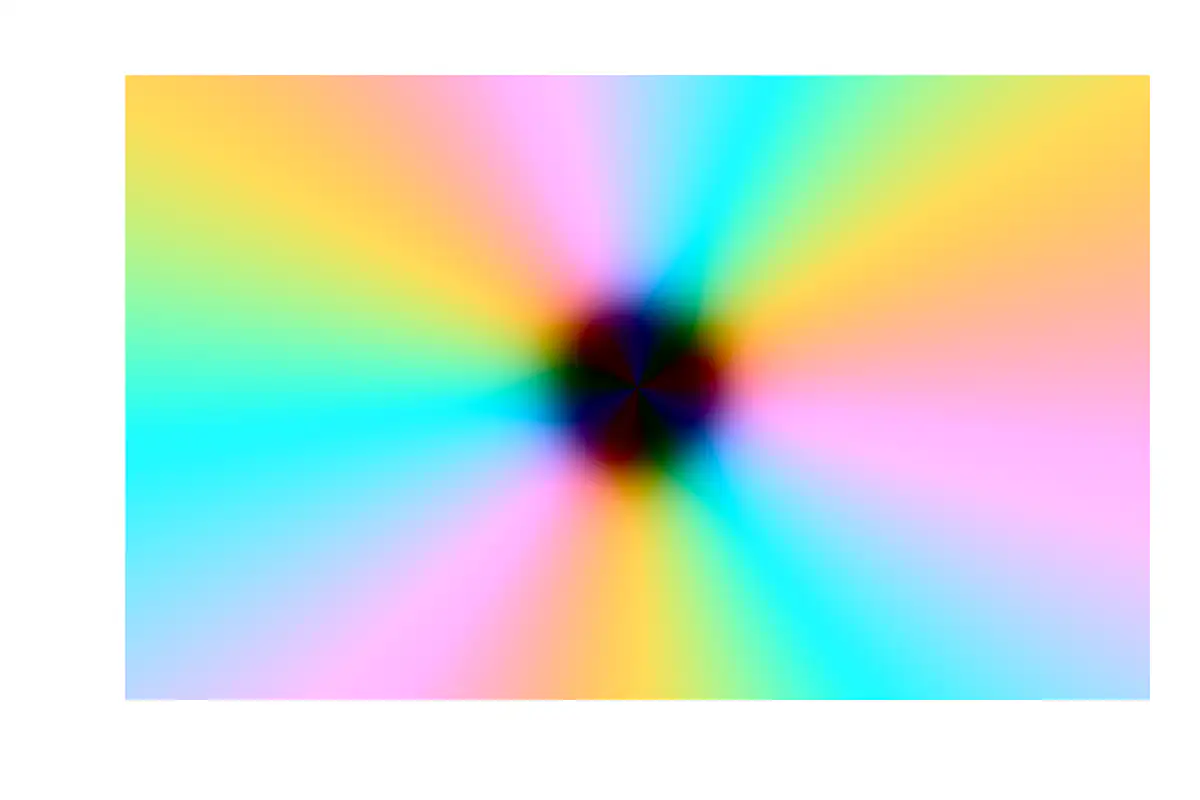
A complex power z^a whose exponent animates, winding the phase more times around the origin.
Domain coloring is a technique for visualizing complex-valued functions by assigning a color to each input point in the complex plane. Hue typically encodes the argument (phase) of the function value, while brightness or saturation encodes the magnitude. The method was popularized in the 1990s by Frank Farris and others and has since become a standard tool for studying analytic functions, conformal maps, and the geometry of poles and zeros.
Here the plot renders f(z) = z^a over -3 \le x, y \le 3 — every pixel a complex input x + yi colored by f(z) — while the exponent a animates from 1 to 5 . Hue encodes the argument, so the phase winds a times around the origin: as a grows the color wheel repeats more often around the central zero, and the principal branch's cut along the negative real axis sharpens. Watching the winding density change is a direct visual read on how the exponent reshapes the map.
JavaScript is required to view the interactive plot.