
Mandelbrot Set
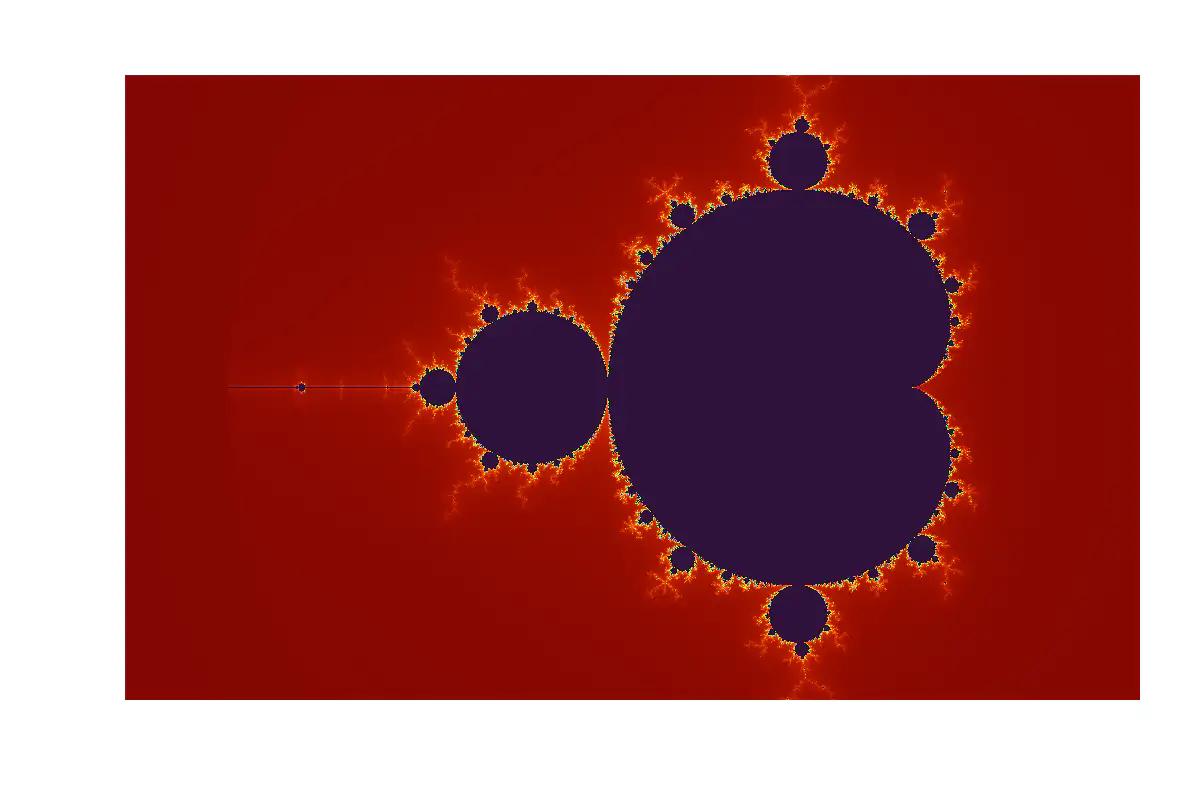
The classic fractal defined by iterating complex quadratic polynomials.
The Mandelbrot set is the set of complex numbers c for which the iteration z \to z^2 + c , starting at zero, never escapes to infinity. First imaged by Robert Brooks and Peter Matelski in 1978 and then explored and popularized by Benoit Mandelbrot in 1980, the set has become one of the most recognized images in mathematics and a touchstone example of fractal geometry. The set sits in the complex plane and serves as a parameter-space catalog of quadratic Julia sets: a value of c lies in the Mandelbrot set exactly when its corresponding Julia set is connected.
The rendering samples c over the rectangle -2.5 \le x \le 1 and -1.5 \le y \le 1.5 , with up to 256 iterations per pixel and a vivid spectral palette that grades exterior points by how quickly they escape. The dense central body and its attached bulbs are points whose orbits stay bounded through the iteration limit. The striking visual feature is the boundary: at every zoom level new filaments, mini-Mandelbrots, and self-similar structure appear, a signature of the set's infinite complexity and fractional Hausdorff dimension.
JavaScript is required to view the interactive plot.