
Seashell
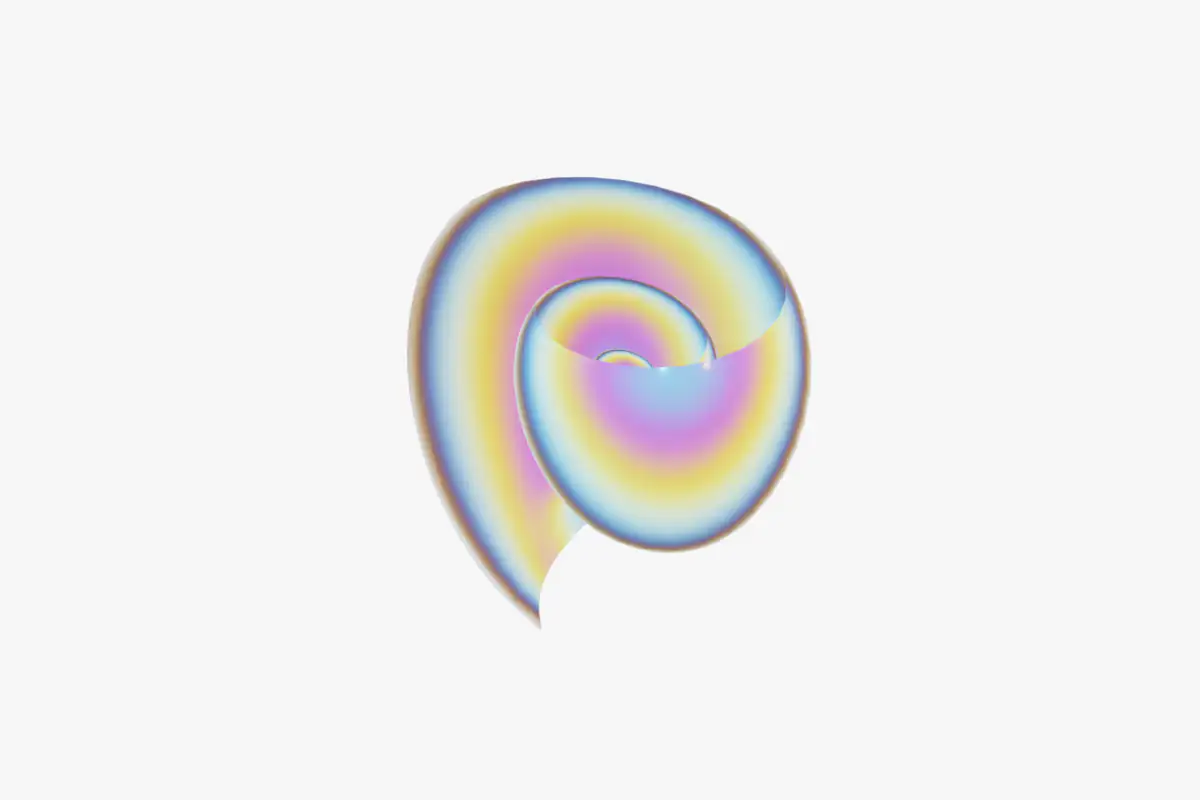
A logarithmic spiral shell — nature’s own parametric surface.
Many real seashells are well approximated by a logarithmic spiral wound in three dimensions. Henry Moseley showed in 1838 that the geometry of mollusk shells follows from just a few growth parameters: a constant rate of angular advance, a constant radial expansion rate, and a constant aperture shape. The same equiangular-spiral principle that gives nautilus shells their iconic form recurs in goat horns, fern fronds, and the cochlea of the inner ear.
The parametric surface coils u from 0 to 6\pi for the spiral and lets v shape the cross-section through sine and cosine terms. The scale factor s = (e^{u/(6\pi)} - 1)/(e - 1) increases the cross-section steadily from the tip outward, producing a smoothly widening shell. The pearl material and hidden wireframe keep focus on the surface, while the logarithmic growth law gives the model its characteristic self-similar appearance: each turn is a scaled copy of the previous one.
JavaScript is required to view the interactive plot.