
Torus Knot Family
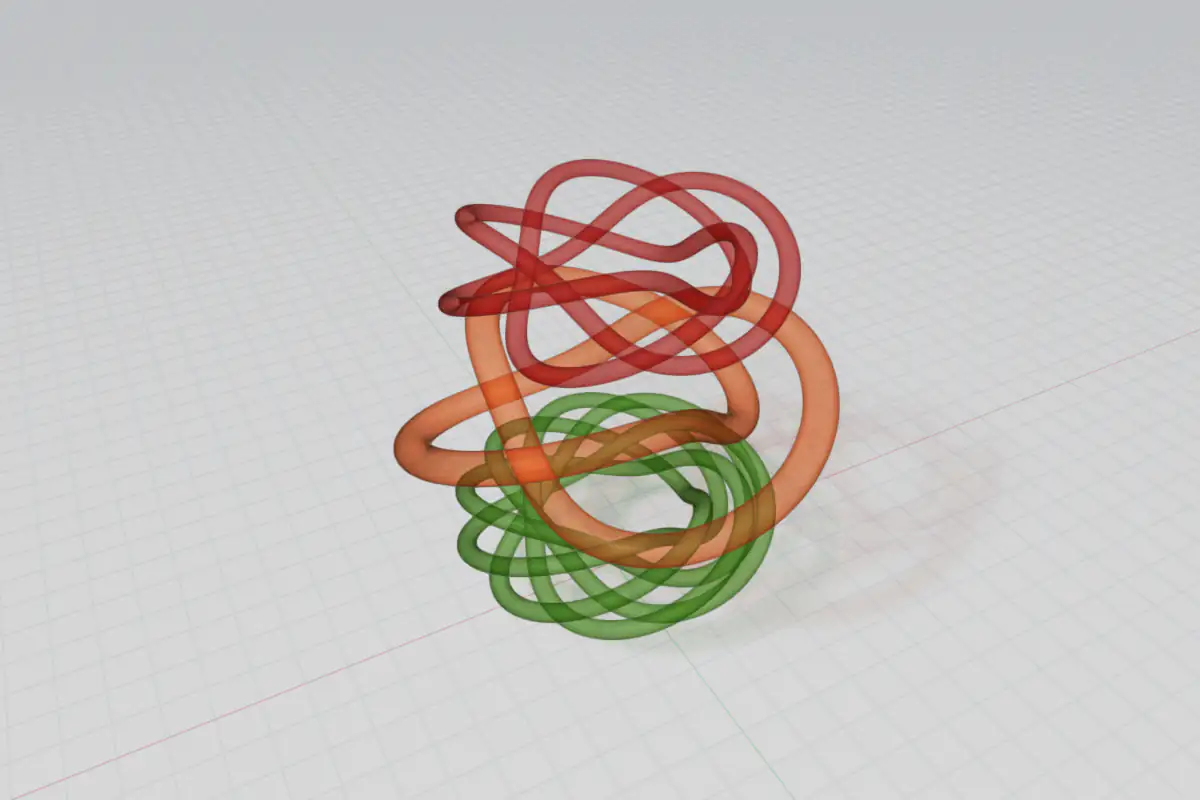
Three torus knots at different winding ratios stacked in one scene.
A torus knot (p, q) is a closed curve that wraps p times around the central axis of a torus and q times around its tube before joining back to itself. For coprime p and q the curve forms a non-trivial knot; otherwise it splits into a link of unknotted loops. Torus knots are the simplest infinite family of knots, are central to braid theory and 3-manifold topology, and serve as a recurring testbed in knot-invariant computations such as the Alexander, Jones, and HOMFLY polynomials.
The visualization shows three examples — (2, 3) , (3, 5) , and (5, 8) — each parameterized using a radius term 1.8 + 0.55\cos(qt) , rotated by pt and lifted by \sin(qt) . The three knots are stacked at different z offsets and colored separately so that the increase in winding complexity is immediate: the (2, 3) is the trefoil, the (3, 5) is a familiar pentagonal pretzel, and the (5, 8) is a denser closed braid.
JavaScript is required to view the interactive plot.