
Chladni Plate
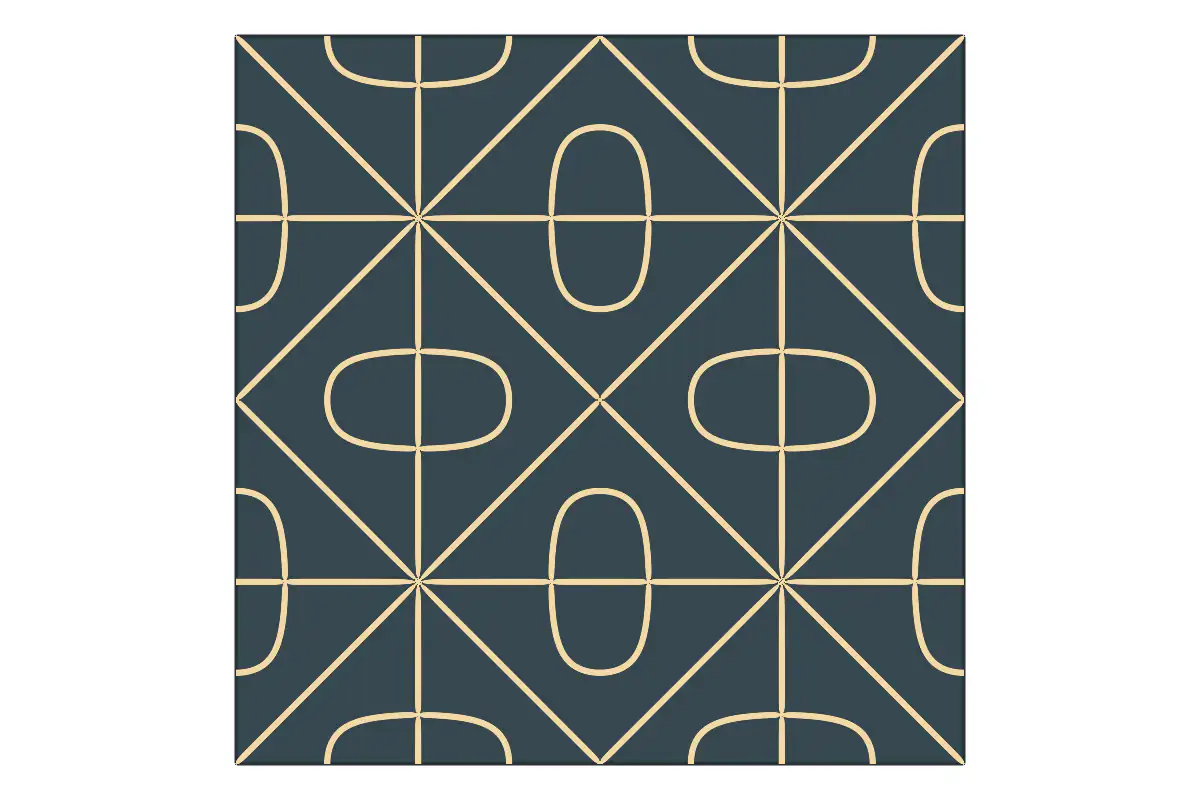
Drag the sliders n and m: sand on a vibrating square plate collects on the nodal lines cos(nπx)cos(mπy) − cos(mπx)cos(nπy) = 0.
When a plate vibrates, sand on it collects on the nodal lines, where the plate does not move. The patterns are called Chladni figures, after Ernst Chladni. For a square plate of side 2, here the square from -1 to 1 in x and y , a simple model of the modes is \cos(n\pi x)\cos(m\pi y) - \cos(m\pi x)\cos(n\pi y) = 0 : the difference of two standing waves of the same frequency, with the roles of n and m exchanged.
The model is after Ritz (1909), and it is the approximation that most demonstrations use; it is not the exact eigenfunction of a free plate. The document draws the equation as an implicit curve, the sand, over a filled square, the plate.
The sliders n and m take the whole numbers from 1 to 9; the document opens with n = 3 and m = 5 . With n = m the two terms are equal and the left side is 0 everywhere, so there is no pattern. The diagonals y = x and y = -x are nodal lines for every n \ne m , because an exchange of x and y changes the sign of the left side.
JavaScript is required to view the interactive plot.