
Electric Dipole
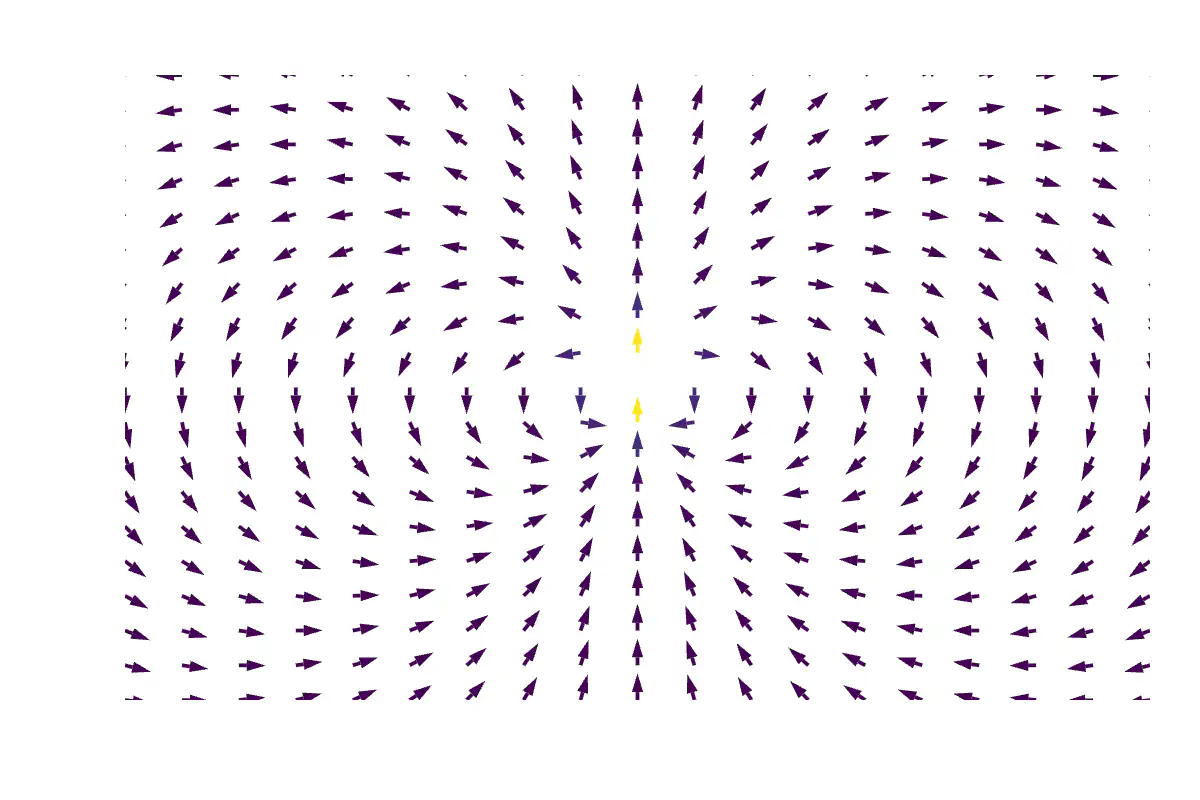
The vector field of a 2D electric dipole, with field lines flowing from positive to negative charge.
An electric dipole is a pair of equal and opposite charges separated by a small distance, and the field it produces is the most important non-trivial multipole in electrostatics. Dipole fields appear in models of polar molecules like water, in dielectric response, in radiation patterns of short antennas, and as the leading correction to a neutral charge distribution observed from far away. The same mathematical form, with vectors reinterpreted, describes magnetic dipoles and gravitational tidal effects.
The visualization shows a two-dimensional dipole-like vector field with components built from x , y , and r = \sqrt{x^2 + y^2} . Arrows are normalized so the direction remains legible even where the magnitude varies sharply, and a viridis magnitude color map adds scalar information underneath. The characteristic dipole topology is clearly visible: field lines bowing outward from one pole, converging on the other, and tracing the figure-eight pattern of equal-magnitude contours around the axis.
JavaScript is required to view the interactive plot.