
Double Helix
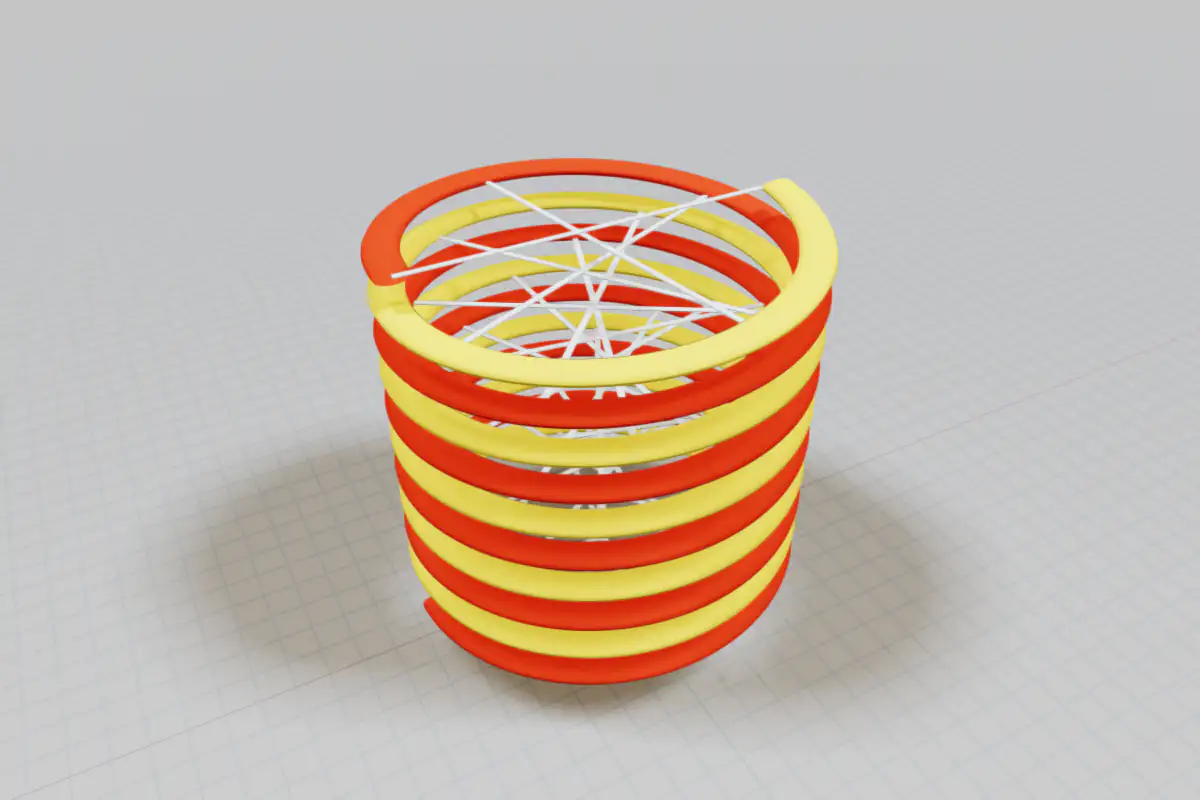
Two intertwined helices joined by rungs — the iconic shape of DNA.
A double helix is a pair of helices with the same axis, pitch, and radius, offset along the shared axis by a constant phase. The structure is best known from the Watson-Crick model of DNA, published in 1953 with crucial X-ray diffraction data from Rosalind Franklin, in which two sugar-phosphate backbones wind around each other while paired bases bridge the gap between them. Double-helix geometry also appears in protein coiled coils and in some twisted polymer fibers.
The visualization draws two helical strands of radius 1.1 with phases separated by \pi , ascending linearly in z from t = 0 to 10\pi . Twenty-four connector segments link corresponding points across the two strands, suggesting the base-pair rungs of a DNA ladder. The red and yellow strands and the gray rungs make the constant phase separation visible along the full length, capturing the geometric essence of the structure without modeling any specific molecule.
JavaScript is required to view the interactive plot.