
Gerstner Waves
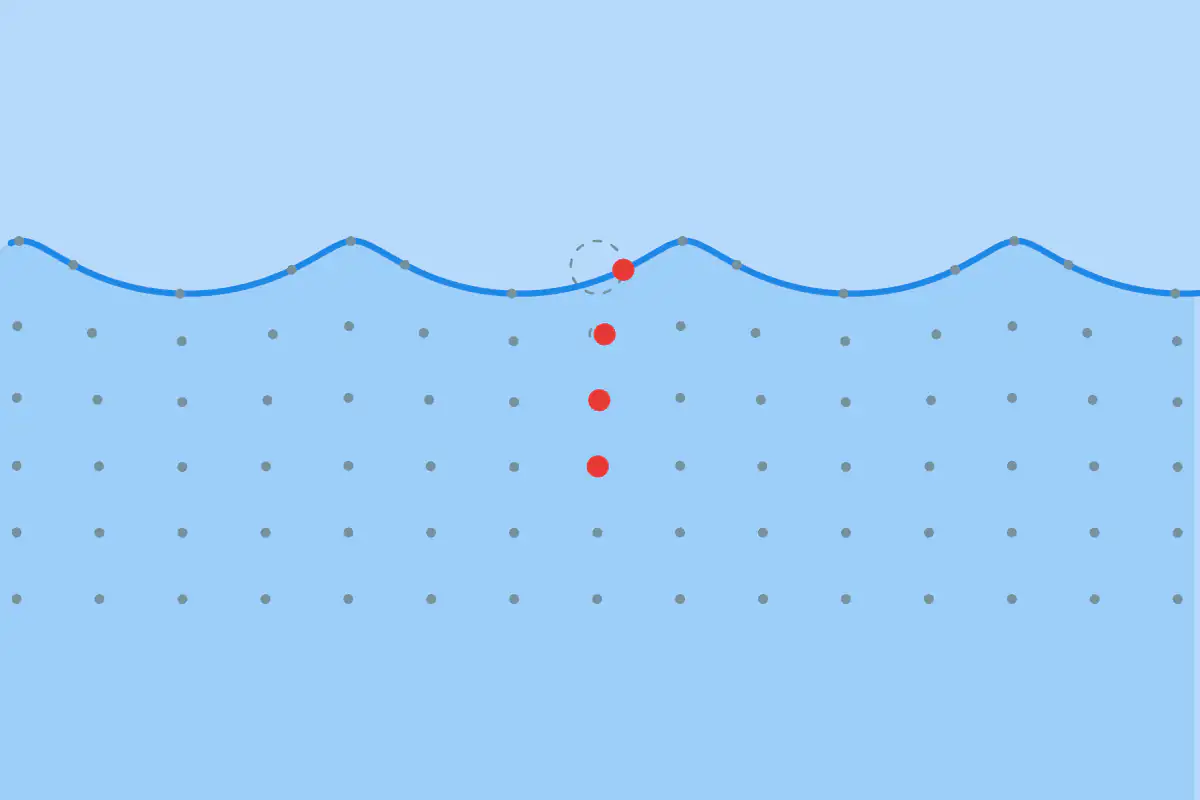
Watch the water in a deep-sea wave: each particle moves on a circle, and the circles shrink with depth. Drag the steepness to sharpen the crests.
In 1802 František Josef Gerstner found an exact solution of the equations of a wave on deep water. Each particle of water moves on a circle. The particle that rests at the position (u, z) is at X(u, z) = u - Ae^{kz}\sin(ku - w T) , Z(u, z) = z + Ae^{kz}\cos(ku - w T) , with the wavenumber k = 2\pi/L , the amplitude A and the angular frequency w = \sqrt{gk} of a deep-water wave.
The surface is the curve of the particles with z = 0 . It is a trochoid, the curve of a point inside a rolling wheel: the crests are sharp and the troughs are flat. The circles shrink as e^{kz} with depth: half a wavelength down they are e^{-\pi} , about 4 %, of the circle at the surface. The water moves round; the wave moves on. The dashed circles are the paths of the red particles, under the crest at u = 0 .
The steepness s = kA runs from 0, a flat sea, to 0.9. At s = 1 the crest becomes a cusp, and a real wave breaks before that. The wavelength is 2 m, so a period is 1.13 s; the time T plays one period in 4 s, 3.5 times slower than the sea. Computer graphics uses sums of Gerstner waves to draw the sea in films and games.
JavaScript is required to view the interactive plot.