
Joukowsky Airfoil
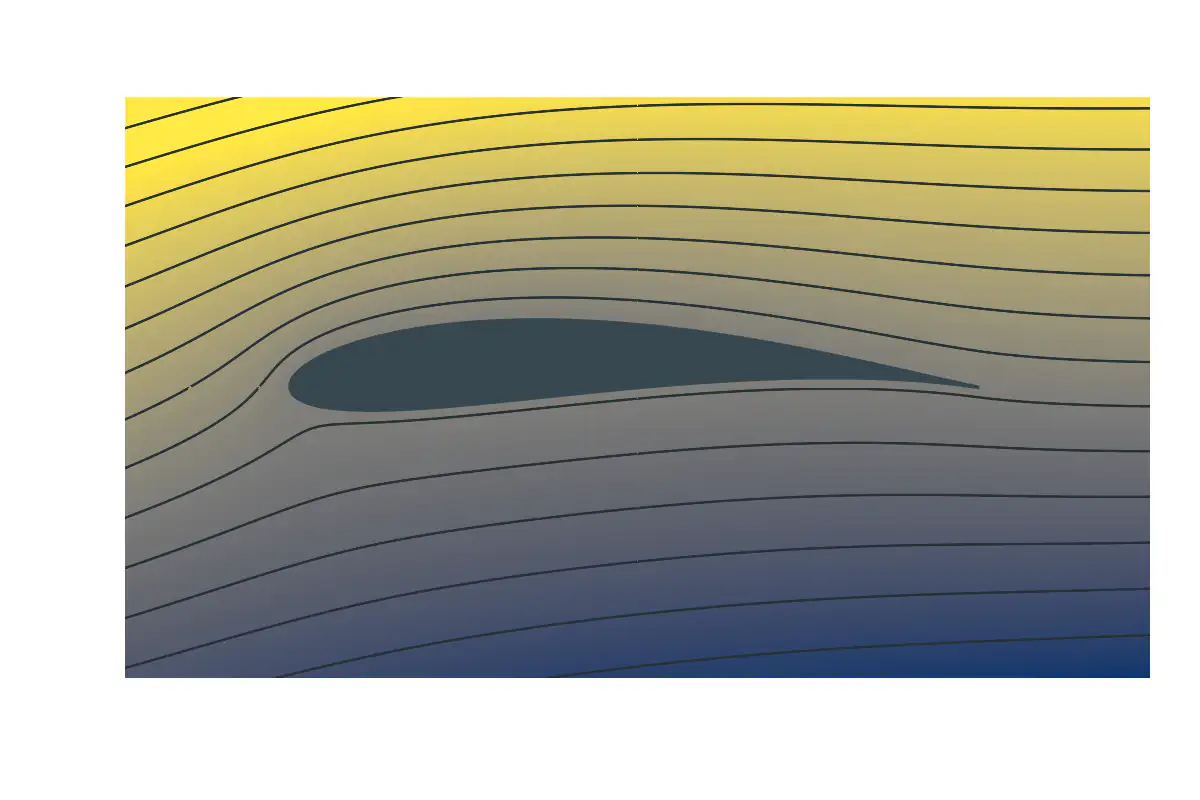
Air flowing past a wing, found by mapping the flow around a circle with Z = z + 1/z; the angle of attack animates.
In 1910 Nikolai Joukowsky found a simple way to compute the airflow around a wing. The flow of an ideal fluid around a circle is known exactly, and the map Z = z + 1/z sends a circle through the point z = 1 to a wing-shaped curve with a sharp trailing edge. Because the map preserves angles, it carries the circle's flow to the flow around the wing.
In this document the circle has its centre at (c_x, c_y) and passes through z = 1 , so its radius is R . The stream function \psi of the flow around the circle combines a uniform wind at the angle of attack a , its reflection in the circle, and a circulation \Gamma . To find \psi at a point of the wing plane, the document inverts the map: u , v , m , s and w compute the complex square root of Z^2 - 4 in real numbers, and k keeps the root outside the circle. The shading shows \psi , and the curves \sin(\pi \psi/0.25) = 0 are the streamlines, the paths that the air follows.
The circulation is set by the Kutta condition: the air must leave the sharp trailing edge smoothly. That fixes \Gamma = 4\pi R\sin(a + \arcsin(c_y/R)) , and the lift on the wing is proportional to \Gamma . As a animates, watch the streamlines crowd together above the wing, where the air moves faster and the pressure is lower. Edit c_x to make the wing thicker or thinner, and c_y to change its curvature.
After a Desmos graph by Fabrice Neyret.
JavaScript is required to view the interactive plot.