
Pendulum Wave
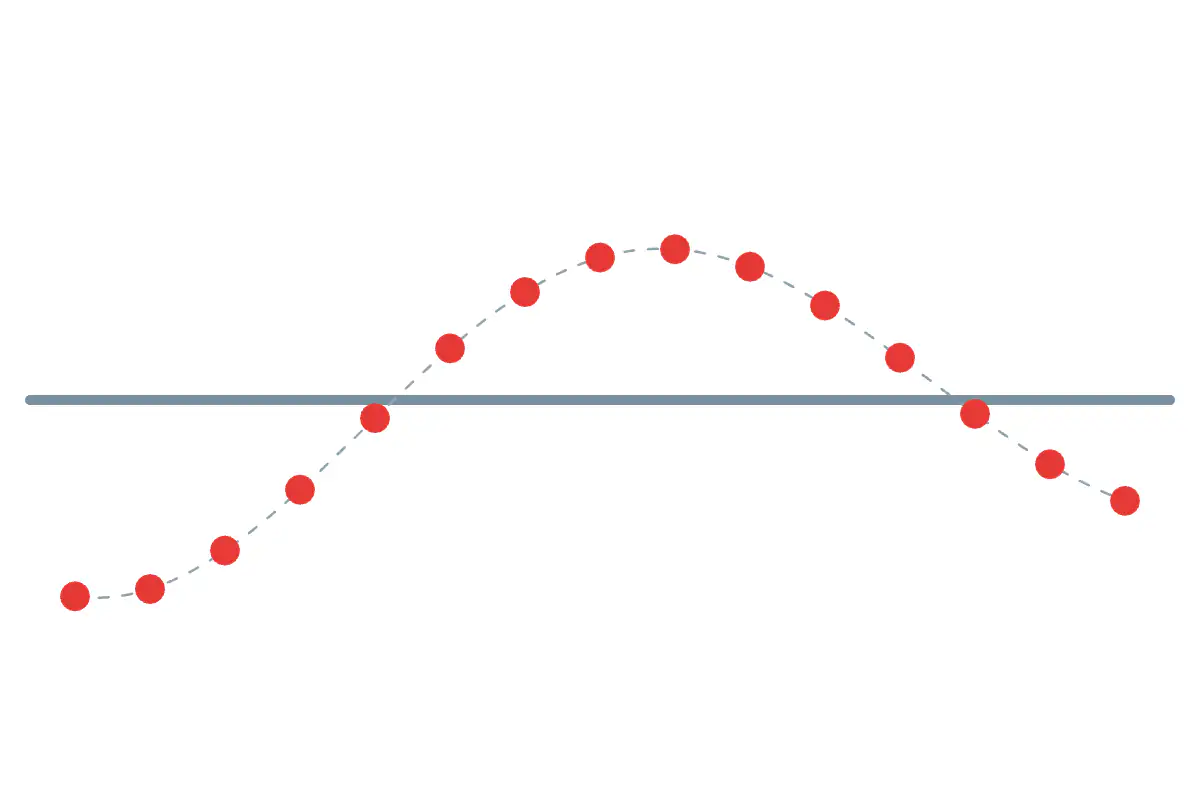
Watch 15 pendulums of different lengths swing in and out of step: travelling waves, two rows at 30 s, and all in line again after 60 s.
A pendulum wave is a row of pendulums of slightly different lengths that start together. This document shows fifteen of them from above, hanging 5 cm apart from a bar. Pendulum j makes 51 + j swings in 60 seconds, so its angular frequency is \omega(j) = 2\pi(51 + j)/60 , and its length follows from the small-angle period 2\pi\sqrt{L/g} : L(j) = g/\omega(j)^2 , from 33.1 cm for the first pendulum to 20.5 cm for the last.
All the pendulums start at the angle \theta_0 = 0.25 radian. Seen from above, the bob of pendulum j is at the distance d(j) = L(j)\theta_0\cos(\omega(j)T) from the bar, the small-angle approximation of L\sin\theta . The phases drift apart at the steady rate of 2\pi/60 per pendulum per second, so the bobs form a travelling wave, then two, then three. At T = 30 s every second pendulum is at the other end of its swing, and at T = 60 s every pendulum has made a whole number of swings and they are in line again.
The dashed curve is d with j as a continuous variable: the wave on which the bobs lie. The time T animates from 0 to 60 seconds in 30 seconds of playback, from the moment the document opens.
JavaScript is required to view the interactive plot.