
Rainbow in the Sky
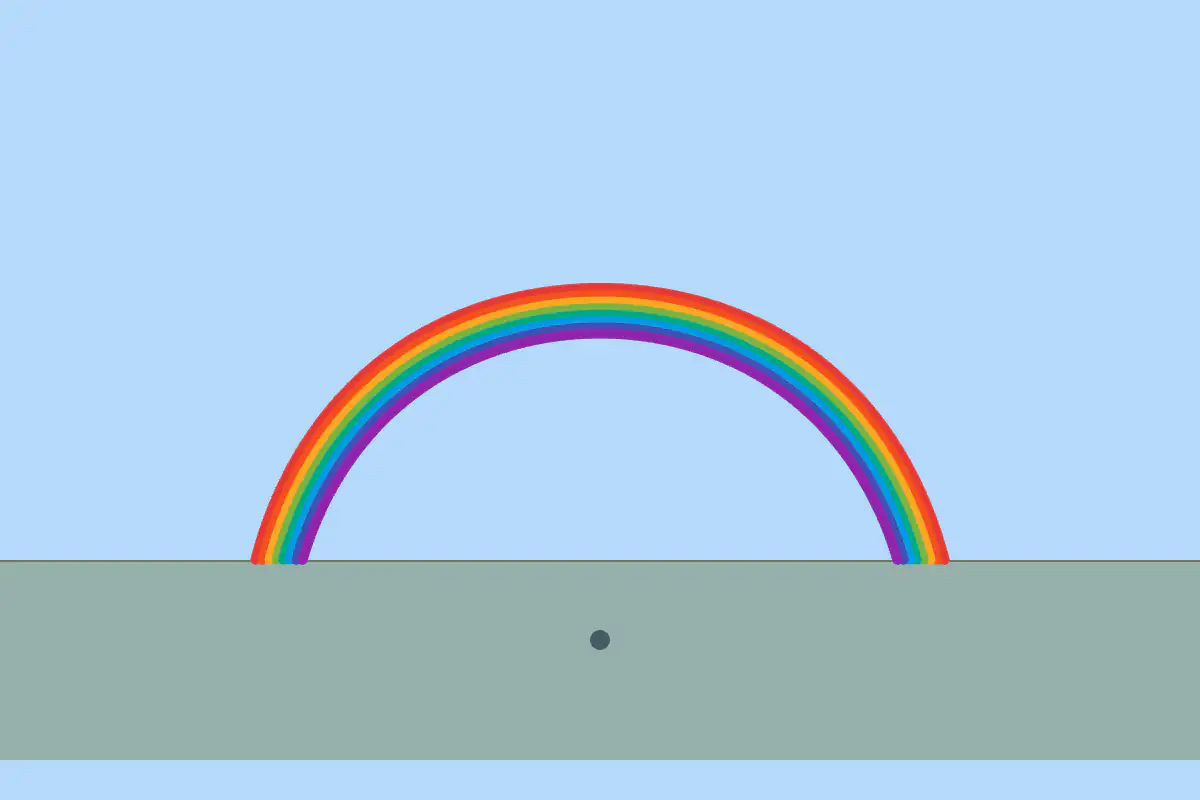
Drag the slider for the height of the sun: the rainbow is a circle round the point opposite the sun, so it sinks as the sun rises, and then disappears.
A rainbow is part of a circle. Light of each color leaves the raindrops at most at the rainbow angle D from the direction back to the sun, and the light bunches up at that angle. So an observer with the sun behind them sees a bright circle of angular radius D round the antisolar point, the direction opposite the sun, where the shadow of their head falls. This document uses the droplet model of the Rainbow Refraction entry: the refractive index N(L) = 1.32 + 0.04L , the impact height of minimum deviation y_m(L) = \sqrt{(4 - N(L)^2)/3} , and D(L) = 4\arcsin(y_m(L)/N(L)) - 2\arcsin(y_m(L)) . Red has the largest angle, so it is on the outside.
The plot is the sky in degrees: x is the azimuth from the antisolar point and y the elevation above the horizon, so the horizon is a straight line. With the sun at the height h_0 , the antisolar point is at the elevation -h_0 , below the horizon, and only the part of each circle above the horizon is drawn. As the sun rises, the bow sinks, and it is gone when h_0 passes the rainbow angle.
The index range of the model is about twice the real spread of water, as in Rainbow Refraction, so that the colors are easy to tell apart. The bow is therefore about 6° wide, from 38.3° for violet to 44.0° for red: about three times wider than the 2° of a real rainbow. It disappears when the sun is between 38° and 44° high. The slider for h_0 runs from 0° to 45°.
JavaScript is required to view the interactive plot.