
Inner Solar System
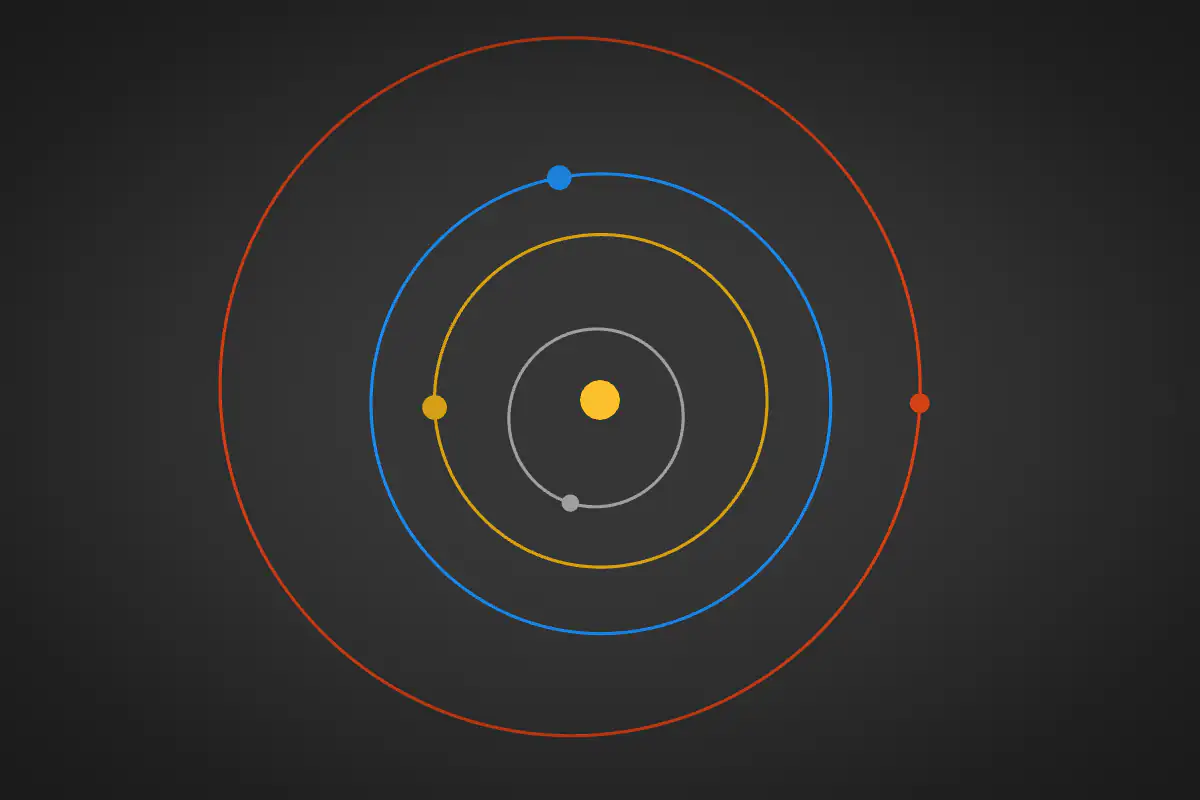
Mercury, Venus, the Earth and Mars on their real orbits, from their orbital elements at the start of the year 2000. Each planet moves by Kepler's laws.
The four inner planets, seen from the north of the plane of the Earth's orbit. The orbits and the positions come from the Keplerian elements that JPL publishes for the epoch J2000, 1 January 2000 at noon (E. M. Standish, "Keplerian Elements for Approximate Positions of the Major Planets"). For each planet: the semi-major axis R in astronomical units, the eccentricity Q , the longitude of the perihelion W and the mean longitude L_0 at J2000, in degrees, and the period P in years. The small tilts of the orbits, 7° at most, are left out.
Each orbit is an ellipse with the Sun at a focus, drawn as the polar curve r = R(1 - Q^2)/(1 + Q\cos(\theta - W)) . To place a planet at the time T , the mean anomaly M = 2\pi T/P + L_0 - W (in radians) grows at a constant rate. Three Newton steps solve Kepler's equation M = E - Q\sin E for the eccentric anomaly E , and the position on the ellipse follows from E . The planet moves fastest at its perihelion, as Kepler's second law says; this is easiest to see on Mercury, whose orbit has the eccentricity 0.21.
The periods follow Kepler's third law, P = R^{3/2} in years and astronomical units. T is the time in years from J2000 and plays two years in 24 s, a little more than one turn of Mars.
JavaScript is required to view the interactive plot.