
Vibrating Drum
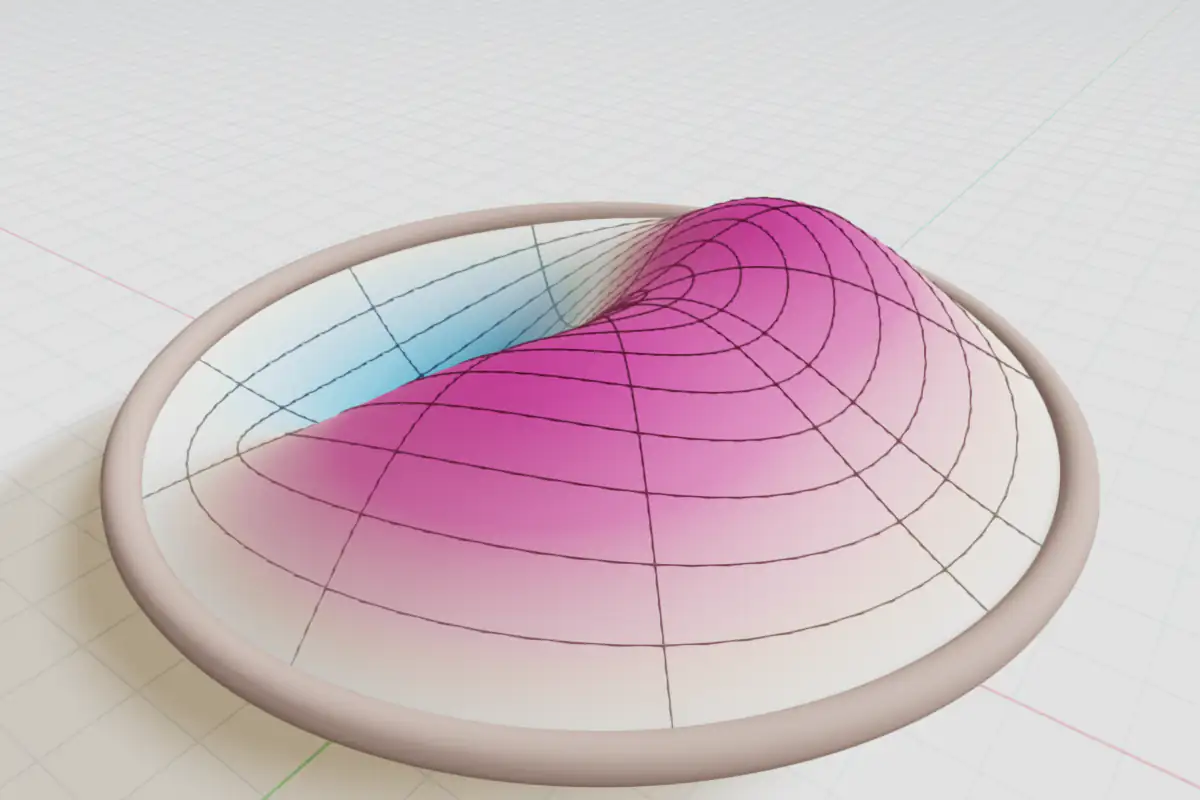
A circular drumhead with a fixed rim, vibrating in three normal modes at once: Bessel functions in motion.
When you strike a drum, its skin vibrates as a combination of normal modes: shapes that keep their form and only change in amplitude as they swing up and down. For a circular membrane with a fixed rim, each mode is a Bessel function in the radius times a cosine in the angle: J_m(k r)\cos(m\theta) . The rim stays still only when k is a zero of J_m , and each mode then vibrates at the frequency k .
This document adds three modes: the fundamental (m = 0 , k = 2.4048 ), where the whole skin moves up and down together, and the first modes with one and two nodal lines across the drum (m = 1 , k = 3.8317 and m = 2 , k = 5.1356 ). The colors show the displacement at each instant: magenta is up, blue is down, and white is level with the rim. A white point is crossing its rest height, not standing still; only the rim never moves. The amplitudes a_1 , a_2 , a_3 are editable: set two of them to 0 to watch one mode alone.
The frequencies are in the ratios 1 : 1.593 : 2.136 , which are not whole numbers, so the shape never repeats. That is why a drum has a less definite pitch than a guitar string, whose overtones are exact multiples of its fundamental.
After a Desmos graph by MYoung, which shows a membrane stretched between two moving rings.
JavaScript is required to view the interactive plot.